
STEAM Career Spotlight: Aerospace Engineer
Prepare for liftoff as we explore the dynamic world of aerospace engineering! As part of our STEAM Career Spotlight series, we’re aiming for the stars and diving into the field that takes humanity to new heights. In this edition, we’ll uncover what it means to be an aerospace engineer, explore high-flying career opportunities, and highlight an inspiring pioneer in the field—Dr. Aprille Ericsson.
What Is an Aerospace Engineer?
An aerospace engineer is a professional who designs, develops, tests, and oversees the manufacturing of aircraft, spacecraft, satellites, and missiles. They blend principles of physics, mathematics, and materials science to solve complex problems related to flight both within and beyond Earth’s atmosphere. Their work is essential for innovation in defense, communication, weather monitoring, and space exploration.
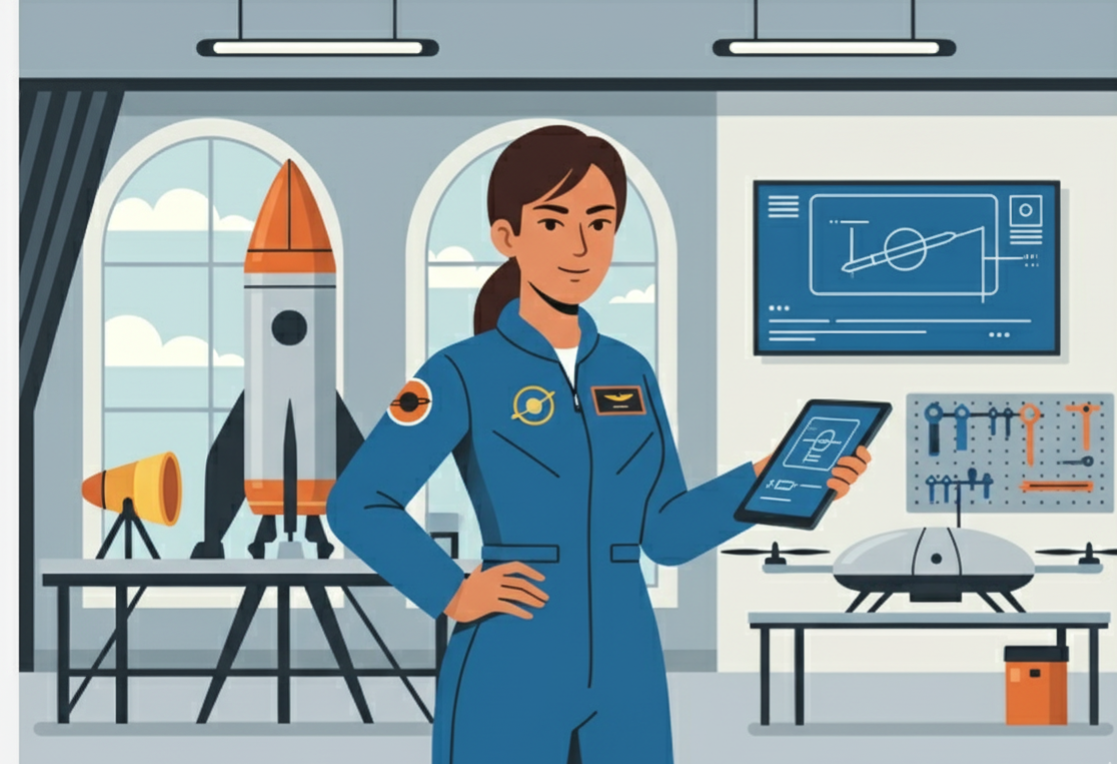
What Does an Aerospace Engineer Do?
Aerospace engineers turn concepts into reality, managing the entire lifecycle of a flight vehicle. They are systems thinkers who must ensure that massive, complex machines operate safely, efficiently, and reliably under extreme conditions.
Core Responsibilities:
Aeronautical Design: Focusing on vehicles that operate within Earth's atmosphere. This includes designing airplanes, jets, helicopters, and drones. Engineers in this area focus on aerodynamics (how air flows over surfaces), propulsion, and structural integrity.
Astronautical Design: Focusing on vehicles that operate outside Earth's atmosphere. This involves designing rockets, satellites, space capsules, and planetary rovers. This requires deep knowledge of orbital mechanics, remote navigation, and life-support systems.
Propulsion Systems: Designing the engines that create thrust. This can range from jet engines and turboprops for aircraft to the massive solid-fuel and liquid-fuel rocket engines needed to escape Earth's gravity.
Structural Analysis & Materials: Selecting and testing materials (like titanium alloys or carbon-fiber composites) that are both lightweight and strong enough to withstand extreme temperatures, pressures, and speeds.
Guidance, Navigation, and Control (GNC): Developing the "brains" of the vehicle. This involves designing the complex computer systems, sensors, and software that control a vehicle's path, orientation, and stability, whether it's an autopilot system or a probe navigating to Mars.
Careers in Aerospace Engineering
The field offers a wide range of specialized and high-impact career paths, including:
Aerodynamics Engineer: Specializes in airflow and vehicle shape to reduce drag and improve fuel efficiency.
Propulsion Engineer: Develops and tests engines and power systems.
Structural Analyst: Ensures the vehicle's airframe is safe and can handle operational stress.
Flight Test Engineer: Manages the testing of new aircraft and spacecraft to validate performance and safety.
Systems Engineer: Integrates all the different components (propulsion, GNC, structures) into one cohesive, functioning system.
Satellite Engineer: Focuses specifically on the design, launch, and operation of satellites for communication, GPS, or scientific research.
With a global focus on defense, commercial spaceflight (SpaceX, Blue Origin), and climate monitoring, demand for skilled aerospace engineers remains strong.
Get to know Aprille Ericsson

Aprille Ericsson is a trailblazing aerospace engineer at the NASA Goddard Space Flight Center (GSFC). Raised in Brooklyn, New York, her passion for science led her to the Massachusetts Institute of Technology (MIT), where she earned her B.S. in Aeronautical/Astronautical Engineering. She continued her studies at Howard University, where she made history as the first African-American woman to receive a Ph.D. in Mechanical Engineering.
At NASA, Dr. Ericsson has served as an instrument manager and engineer for numerous critical missions. Her work has been vital to projects like the Tropical Rainfall Measuring Mission (TRMM), which provided crucial data on climate change, and the James Webb Space Telescope (JWST), helping to manage the systems that allow the telescope to capture stunning images of the early universe.
To learn more about STEAM Ahead, visit us at www.westeamahead.org