
What Is Carbon Dating and How Does It Work?
The term carbon dating is often mentioned in documentaries, museums, and science classes. It may sound highly technical, but beyond the buzzword, carbon dating is simply a scientific method used to estimate the age of once-living materials.
Carbon dating, also called radiocarbon dating, helps researchers determine how old organic objects are. These objects can include bones, wood, cloth, paper, seeds, and even ancient fossils. The method has become one of the most important tools in archaeology and environmental science because it allows scientists to study events from the distant past with greater accuracy.
At the center of carbon dating is a radioactive form of carbon known as carbon-14. Carbon exists naturally in the environment, and most carbon atoms are stable. However, a small amount exists as carbon-14, which slowly breaks down over time.
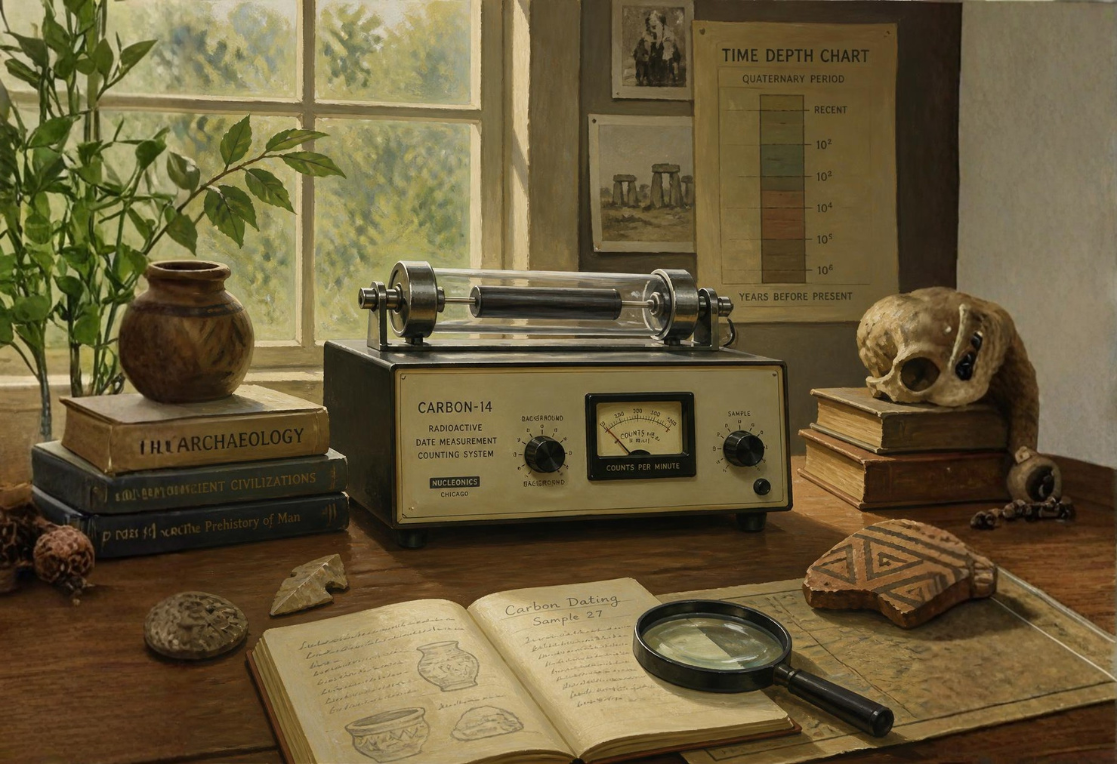
How Carbon Dating Works
All living organisms absorb carbon while they are alive. Plants take in carbon dioxide from the atmosphere during photosynthesis, while animals absorb carbon by eating plants or other animals. As long as an organism remains alive, the amount of carbon-14 inside it stays relatively constant.
When the organism dies, it no longer absorbs carbon. At that point, the carbon-14 inside it begins to decay at a predictable rate. Scientists measure how much carbon-14 remains in the object compared to the amount expected in a living organism.
Carbon-14 decays slowly over time and has a half-life of about 5,730 years. A half-life is the amount of time it takes for half of the radioactive atoms to break down. By calculating how much carbon-14 is left, scientists can estimate the age of the sample.
This process allows researchers to date objects that are up to around 50,000 years old.
Why Carbon Dating Matters
Carbon dating has transformed the study of human history and ancient environments. Archaeologists use it to determine the age of artifacts, burial sites, and early settlements. Paleontologists and geologists also use radiocarbon dating to better understand past ecosystems and climate changes.
For example, carbon dating has helped scientists study ancient civilizations, track migration patterns, and estimate the age of historical discoveries such as preserved textiles and wooden tools.
The method also plays an important role in environmental science. Researchers use carbon dating to study ocean circulation, forest growth, and changes in Earth’s atmosphere over time.
Limitations of Carbon Dating
Although carbon dating is extremely useful, it is not perfect. The method only works on materials that were once alive. Rocks and metals usually cannot be dated using carbon-14.
Accuracy can also be affected by contamination. If a sample is exposed to newer carbon during handling or preservation, the results may appear younger than they actually are.
In addition, carbon dating becomes less reliable for objects older than about 50,000 years because so little carbon-14 remains.
Looking Ahead
Scientists continue to improve carbon dating techniques using advanced instruments and calibration methods. These improvements help researchers produce more accurate age estimates and learn more about Earth’s history.
Carbon dating may sound like a complex scientific term, but its core idea is straightforward: by studying radioactive carbon, scientists can uncover the timeline of the past and better understand the history of life on Earth.
To learn more about STEAM Ahead, visit us at www.westeamahead.org